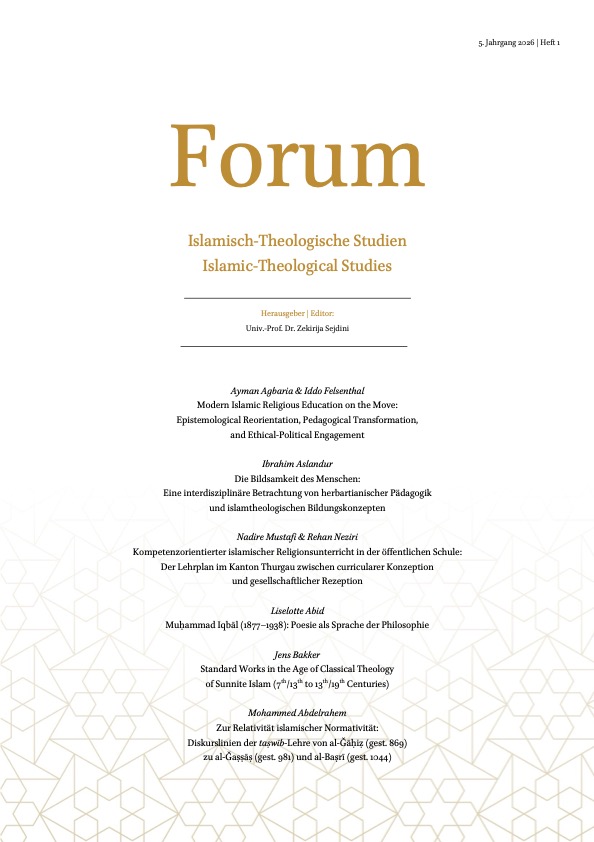
Modern Islamic Religious Education on the Move
Epistemological Reorientation, Pedagogical Transformation and Ethical-Political Engagement
DOI:
https://doi.org/10.71573/2941-122X_2026_5-1_163Schlagwörter:
Modern Islamic Religious Education, Critical Fidelity, Political Engagement, PluralismAbstract
Modern Islamic Religious Education (MIRE) reconciles traditional confessional instruction with contemporary critical inquiry. Drawing on the works of Muslim thinkers active in the West, namely, Mohammed Arkoun, Abdolkarim Soroush, and Tariq Ramadan, it is based on three foundations: epistemological reorientation, pedagogical transformation, and ethical-political engagement. Arkoun introduces deconstruction of orthodox power structures; Soroush advances epistemological pluralism and dialogical reasoning; and Ramadan links revelation to civic responsibility. Their approach is one of religious experimentality reanimating the relations between text and context and permitting educators to be pedagogical bricoleurs. Together, they shape a dynamic educational model cultivating learners as mukallafīn – morally responsible, critically reflective, and civically engaged individuals.
Downloads
Veröffentlicht
Ausgabe
Rubrik
Lizenz
Copyright (c) 2026 Ayman Agbaria, Iddo Felsenthal (Autor/in)

Dieses Werk steht unter der Lizenz Creative Commons Namensnennung 4.0 International.
FORUM is committed to Diamond Open Access. All articles and reviews are freely accessible from the date of publication, with no charges for authors (APCs) or readers. FORUM relies on the technical and financial support of the University of Innsbruck to ensure long-term accessibility.
All published content is licensed under a Creative Commons Attribution 4.0 International License (CC BY 4.0). This allows anyone to share and adapt the material for any purpose, provided proper credit is given. Authors retain full and permanent ownership of their work while granting FORUM a non-exclusive, perpetual right to publish and distribute it.
Authors are responsible for securing rights for any images, illustrations, or figures included in their work. They are encouraged to share their published articles in institutional repositories or personal websites to maximize visibility. Additionally, authors may enter into separate agreements for non-exclusive distribution, provided the original publication in FORUM is acknowledged.
FORUM does not charge reprint fees, and no additional permission is required for republication, as authors retain copyright.