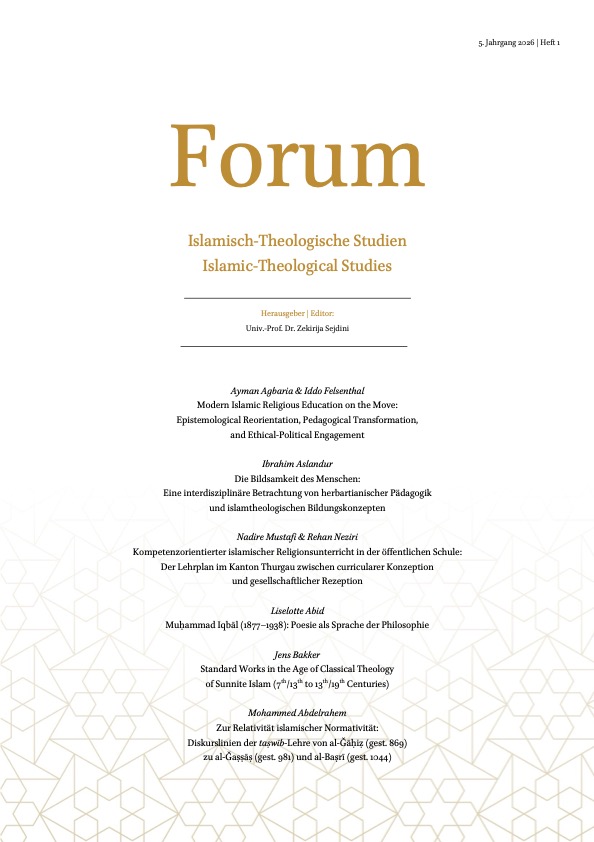
Kompetenzorientierter islamischer Religionsunterricht in der öffentlichen Schule
Der Lehrplan im Kanton Thurgau zwischen curricularer Konzeption und gesellschaftlicher Rezeption
DOI:
https://doi.org/10.71573/2941-122X_2026_5-1_158Keywords:
Islamic Religious Education in Switzerland, Curriculum 21, competence orientation, curriculum analysis, receptionAbstract
The new curriculum for Islamic religious education in the Canton of Thurgau is the first of its kind in Switzerland. This article explores the opportunities and challenges that its competencybased design poses for teaching practice, teachers, and school institutions, and how various societal actors assess it. A triangulated methodology is applied: first, the curriculum is analyzed in comparison with existing curricula from Switzerland, Germany, and Austria; second, statements from Muslim communities, church institutions, state authorities, and teachers are qualitatively examined. This dual perspective provides a nuanced picture of curricular innovation and its reception, offering impulses for the further development of Islamic religious education in the Swiss context.
Downloads
Published
Issue
Section
License
Copyright (c) 2026 Nadire Mustafi, Rehan Neziri (Autor/in)

This work is licensed under a Creative Commons Attribution 4.0 International License.
FORUM is committed to Diamond Open Access. All articles and reviews are freely accessible from the date of publication, with no charges for authors (APCs) or readers. FORUM relies on the technical and financial support of the University of Innsbruck to ensure long-term accessibility.
All published content is licensed under a Creative Commons Attribution 4.0 International License (CC BY 4.0). This allows anyone to share and adapt the material for any purpose, provided proper credit is given. Authors retain full and permanent ownership of their work while granting FORUM a non-exclusive, perpetual right to publish and distribute it.
Authors are responsible for securing rights for any images, illustrations, or figures included in their work. They are encouraged to share their published articles in institutional repositories or personal websites to maximize visibility. Additionally, authors may enter into separate agreements for non-exclusive distribution, provided the original publication in FORUM is acknowledged.
FORUM does not charge reprint fees, and no additional permission is required for republication, as authors retain copyright.