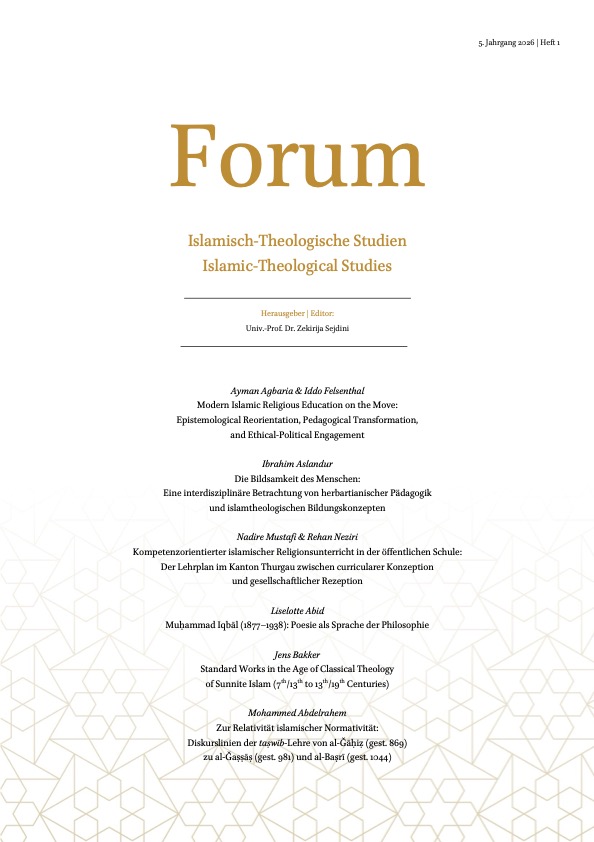
Zur Relativität islamischer Normativität
Diskurslinien der taṣwīb-Lehre von al-Ǧāḥiẓ (gest. 869) zu al-Ǧaṣṣāṣ (gest. 981) und al-Baṣrī (gest. 1044)
DOI:
https://doi.org/10.71573/2941-122X_2026_5-1_154Keywords:
taṣwīb, ijtihād, relativity, Islamic normativity, kalām, legal rationalityAbstract
This article explores the relativity of Islamic normativity through the taṣwīb doctrine (kullu mujtahid muṣīb) as formulated by al-ʿAnbarī and received by al-Jāḥiẓ (d. 255/869), al-Jaṣṣāṣ (d. 370/981), and al-Baṣrī (d. 436/1044). Al-Jaṣṣāṣ reinterprets the thesis through the ḥanafī principle of ashbah bi-l-aṣl as a hermeneutical-methodological approach; al-Baṣrī elaborates it into an epistemo-logical model of normative plurality, while al-Jāḥiẓ articulates a soteriological theory of moral responsibility in the context of kalām. The analysis shows that classical Islamic legal theory developed a distinct modelof normativity that maintains binding force under conditions of pluralism and uncertainty. The article calls for renewed engagement with this tradition in contemporary debates on religious normativity and legal pluralism.
Downloads
Published
Issue
Section
License
Copyright (c) 2026 Mohammed Abdelrahem (Autor/in)

This work is licensed under a Creative Commons Attribution 4.0 International License.
FORUM is committed to Diamond Open Access. All articles and reviews are freely accessible from the date of publication, with no charges for authors (APCs) or readers. FORUM relies on the technical and financial support of the University of Innsbruck to ensure long-term accessibility.
All published content is licensed under a Creative Commons Attribution 4.0 International License (CC BY 4.0). This allows anyone to share and adapt the material for any purpose, provided proper credit is given. Authors retain full and permanent ownership of their work while granting FORUM a non-exclusive, perpetual right to publish and distribute it.
Authors are responsible for securing rights for any images, illustrations, or figures included in their work. They are encouraged to share their published articles in institutional repositories or personal websites to maximize visibility. Additionally, authors may enter into separate agreements for non-exclusive distribution, provided the original publication in FORUM is acknowledged.
FORUM does not charge reprint fees, and no additional permission is required for republication, as authors retain copyright.