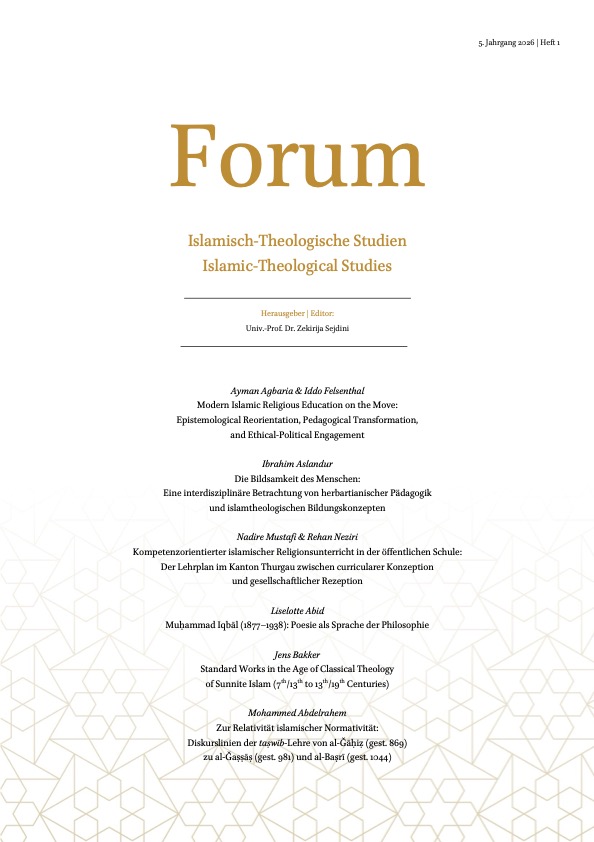
Die Bildsamkeit des Menschen
Eine interdisziplinäre Betrachtung von herbartianischer Pädagogik und islamtheologischen Bildungskonzepten
DOI:
https://doi.org/10.71573/2941-122X_2026_5-1_127Keywords:
Educability, Religious Education, Islamic Theology of Education, Herbart, Qur’anic Hermeneutics, al tarbiyaAbstract
This article examines the concept of human educability (Bildsamkeit ) as a key interface between Johann Friedrich Herbart’s pedagogy and Islamic theology of education from a religious educational perspective. Building on Herbart’s notion of educability as a foundational concept of pedagogy, it highlights conceptual correspondences in Islamic terms such as al-ta ʿlīm (instruction), al-tarbiya (education), and al-ta ʾdīb (moral formation). The Qur’an is interpreted as a dynamic educational process in which divine revelation, cognitive insight, and ethical self formation intersect. The study offers new perspectives for an interreligious pedagogy that conceives the human being as a subject of learning and moral growth, and education as a transformative process
of consciousness and character development.
Downloads
Published
Issue
Section
License
Copyright (c) 2026 Ibrahim Aslandur (Autor/in)

This work is licensed under a Creative Commons Attribution 4.0 International License.
FORUM is committed to Diamond Open Access. All articles and reviews are freely accessible from the date of publication, with no charges for authors (APCs) or readers. FORUM relies on the technical and financial support of the University of Innsbruck to ensure long-term accessibility.
All published content is licensed under a Creative Commons Attribution 4.0 International License (CC BY 4.0). This allows anyone to share and adapt the material for any purpose, provided proper credit is given. Authors retain full and permanent ownership of their work while granting FORUM a non-exclusive, perpetual right to publish and distribute it.
Authors are responsible for securing rights for any images, illustrations, or figures included in their work. They are encouraged to share their published articles in institutional repositories or personal websites to maximize visibility. Additionally, authors may enter into separate agreements for non-exclusive distribution, provided the original publication in FORUM is acknowledged.
FORUM does not charge reprint fees, and no additional permission is required for republication, as authors retain copyright.