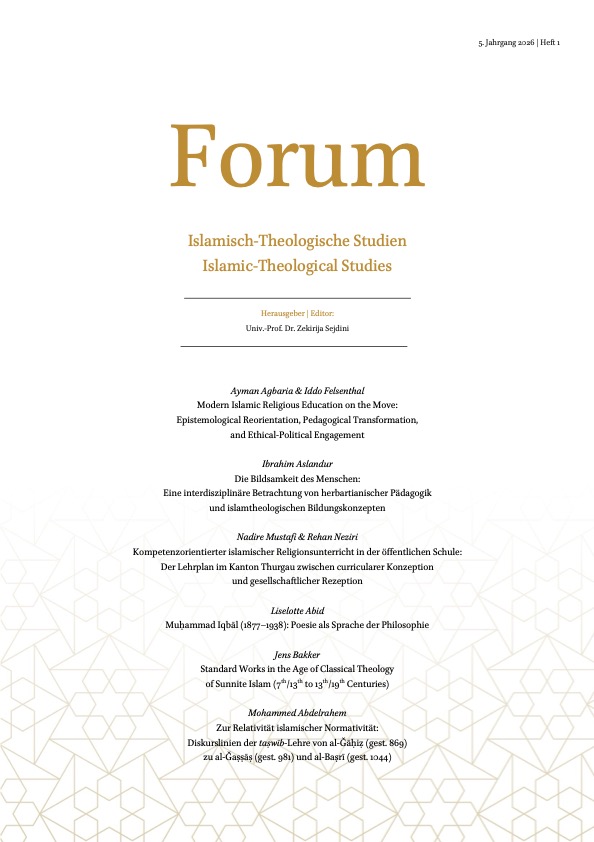
Muhammad Iqbal (1877 - 1938)
Poesie als Sprache der Philosophie
DOI:
https://doi.org/10.71573/2941-122X_2026_5-1_136Keywords:
Muhammad Iqbal, Iqbal‘s philosophy, language of poetry, Islamic reformism, Islamic modernism, intercultural philosophyAbstract
The works of the philosopher and poet Muuḥammad Iqbāl contain elements of Islamic mysticism, of his traditional Islamic education, his studies of law and philosophy in Cambridge, and of his interest in European philosophers and thinkers , especially Hegel and Goethe, but also Nietzsche and Bergson. The spectrum of languages he use d provide s for an inter cultural approach: Persian
as the language of the e ducated class of India, Urdu as medium of communication, Arabic as a part of his traditional Islamic education, English as a language of romanticism and of law, and German, with the option of combining poetry and philosophy. Through this multilingualism Iqbāl was in a position to unfold his vitalist philosophy , expressing or “translating ” it into poetry.
The result is a symbiosis of “three realms of thought”: India, the world of Islam, and western thinking, as Hermann Hesse wrote in his introduction to the German translation of Iqbals Jāvīd Nāmeh or “The Book of Eternity”. In this work I will try to shed light on why and how Iqbāl used the poetical language in order to present his philosophical thoughts in a spiritual context and to spread his reformatory ideas.
Downloads
Published
Issue
Section
License
Copyright (c) 2026 Liselotte Abid (Autor/in)

This work is licensed under a Creative Commons Attribution 4.0 International License.
FORUM is committed to Diamond Open Access. All articles and reviews are freely accessible from the date of publication, with no charges for authors (APCs) or readers. FORUM relies on the technical and financial support of the University of Innsbruck to ensure long-term accessibility.
All published content is licensed under a Creative Commons Attribution 4.0 International License (CC BY 4.0). This allows anyone to share and adapt the material for any purpose, provided proper credit is given. Authors retain full and permanent ownership of their work while granting FORUM a non-exclusive, perpetual right to publish and distribute it.
Authors are responsible for securing rights for any images, illustrations, or figures included in their work. They are encouraged to share their published articles in institutional repositories or personal websites to maximize visibility. Additionally, authors may enter into separate agreements for non-exclusive distribution, provided the original publication in FORUM is acknowledged.
FORUM does not charge reprint fees, and no additional permission is required for republication, as authors retain copyright.